Welcome to the Playground

As scientists, we strive to understand the world through careful observation, hypothesis testing, and empirical validation. The scientific method—centuries-old and time-tested—remains our foundation.
Along this journey, machines have become indispensable allies: they help us analyze data, automate collection, and validate theories—even for those less familiar with statistical methods.
These traditional approaches—designed by humans, for humans—are both rigorous and interpretable. But they face limitations when dealing with the complexity of modern data. Consider a standard digital photograph: millions of pixels, each holding color information. Manually constructing a mathematical rule to detect human faces becomes impractical fast.
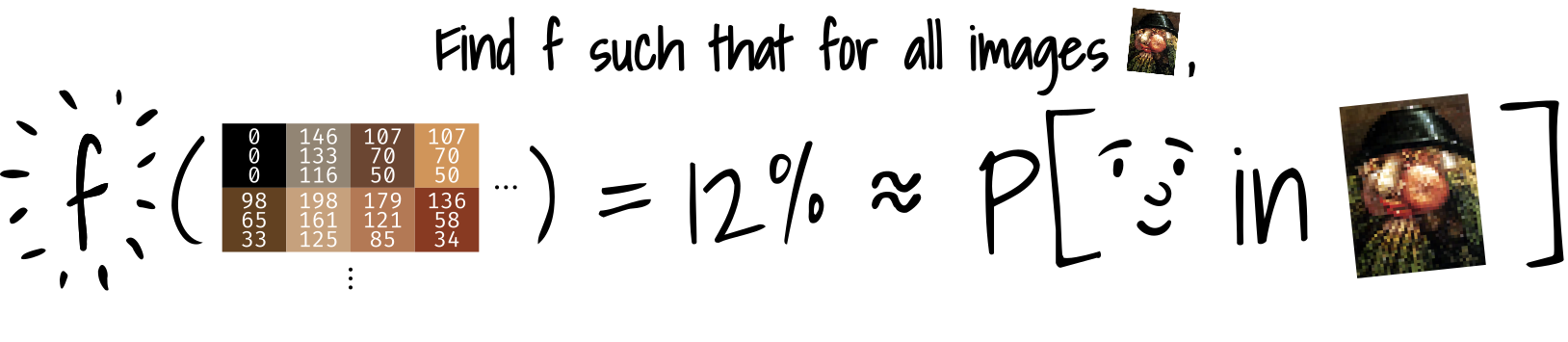
This is where machine learning comes in. As Arthur L. Samuel, a pioneer in the field, put it:
“Machine learning gives computers the ability to learn without being explicitly programmed.”
Rather than defining the function ourselves, we provide a family of candidate functions (the ML method) and a way to evaluate them (a loss function), letting the computer learn from data.
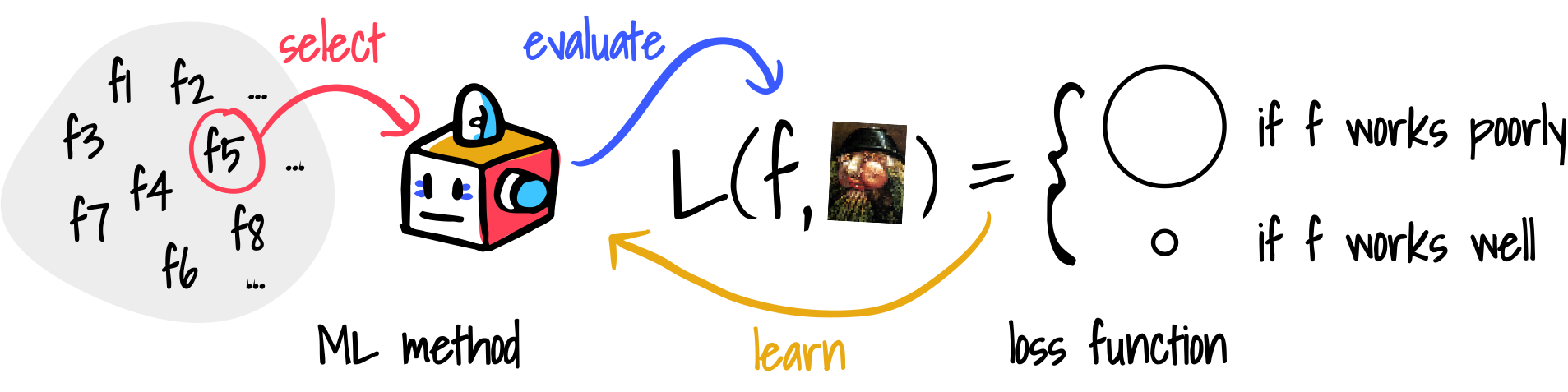
Despite its power, machine learning can feel like a black box. Many practitioners—perhaps including you—hesitate to adopt it because they can’t see why a model makes a particular decision. In science, where understanding is often as important as prediction, this is a real concern.

That’s why we’ve built this playground. It’s a hands-on introduction to explainable machine learning—showing how modern models can be both powerful and transparent. Our aim is to help you explore how these techniques can support your own research, whatever your field.
Whether you’re a sociologist studying behavior, a quantum physicist probing subatomic patterns, or a marine biologist modeling ocean life, you’ll step into the role of a wildlife researcher in our interactive examples.
Prefer general ML terminology over biology-specific language? No problem—you can switch between the two at the top of the page.